
Emilio Fantin. Laboratori
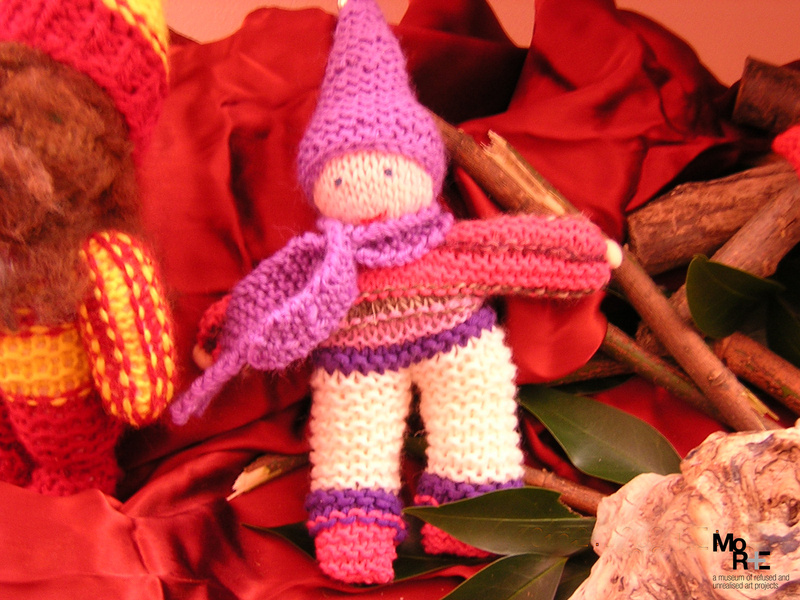
Dolls made to the Waldorf school in the course of the manual arts teacher Patrizia Solina
“Give credit to the quality of the soul in times of suffering and evil means arming oneself with the courage to face the inseparable companions of death: fear and despair. Well, there is no scientific evidence, but we can all verify that it is imperative to create special conditions for a peaceful and loving environment and how this can affect the health of patients and their caregivers. These are the forces that, more than any other discipline, art can convey, given its constant focus on ethics and aesthetics.”
With these words, the artist introduces his project, which involved the creation of a large illustrated book – actually produced and donated to the hospital department and dedicated to the story of The Bremen Town Musicians – and a series of workshops for children organised in collaboration with the teachers of the Maria Garagnani Waldorf School in Bologna, which the artist’s daughters had attended and which he himself had helped to establish. The workshops were titled Meet the Tale and Represent It, Take Care, and Modelling with Hot Beeswax.
The book, measuring 70 × 50 cm, was hand-painted by the artist and dedicated to the tale of The Bremen Town Musicians. As Fantin explains, the story was chosen because it recounts a special friendship among its four characters, which helps them overcome obstacles in order to play together and eventually return home. The work was realised, exhibited in Bologna and donated to the hospital department.
Fantin then conceived a series of workshops. The first, Meet the Tale and Represent It, was addressed to AGEOP staff and presented by Patrizia Solina, a handicrafts teacher at the Garagnani Waldorf School, in collaboration with Catherine Caruso, an after-school teacher at the same school.
The objective was to enhance the traditional fairy tale and its staging as an alternative to other forms of entertainment and play for children. The idea was to ask the teachers to create a series of dolls to be given to the staff, allowing them to stage performances and modify them from time to time together with the children, while also providing instructions on how to make the dolls. The project was based on an understanding of the traditional fairy tale according to the principles of Waldorf pedagogy. For the project, Fantin created a series of watercolour drawings depicting characters that could be used in the narration of three different tales, combined with images of Raphael’s Madonnas, which the artist considered therapeutically effective according to certain iconographic studies cited in the project documentation (Il mio progetto.doc). The documentation of the proposal also includes images of dolls made at the Waldorf School during Patrizia Solina’s handicrafts course.
Take Care, on the other hand, was addressed to AGEOP staff and presented by Carla Borri, an art therapist and teacher of painting and modelling at the Garagnani Waldorf School, in collaboration with Mara Medrano. The workshop was intended to introduce participants to fundamental exercises based on Rudolf Steiner’s Essence of Color and on the theory linking colour and emotion to the forces of the will. The course was therefore designed to provide the staff with tools for exploring colour theory through the use of watercolours made with plant pigments, ox-hair brushes, sheets of paper and small Plexiglas boards.
The project was intended to be divided into twelve two-hour sessions—six devoted to the fundamental exercises from Steiner’s Essence of Color and six to exercises inspired by nursery rhymes focusing on colour—or, alternatively, into six four-hour sessions.
The chosen technique was watercolour on wet paper using vegetable dyes. The final workshop, which does not appear in the catalogue of the exhibition at the GAM, was titled Modelling with Hot Beeswax. It was addressed to AGEOP staff and presented by Carla Borri, a teacher of painting and sculpture at the Waldorf School, in collaboration with Catherine Caruso, an after-school teacher. The aim, as explained by the artist himself, was “to rediscover the charm, warmth and grace of modelling the hot beeswax, colouring it with natural pigments. Beeswax is full of sun, of heat that helps to warm both the body and the soul and brings enthusiasm”. The workshop was intended to provide the staff with the tools to explore this technique so that they could subsequently teach it to the children.
The work can be readily situated within Emilio Fantin’s artistic practice, which is devoted to collective projects of public and relational art based on interaction and, in particular, to exploring the value of design and artistic expression among children and adults, as demonstrated by several workshops organised by the artist himself, including the more recent Trees, Cows, Clouds and Other Subjects, presented as part of the exhibition Recreations. Artists for Mirandola (Mirandola, Modena, 2013).
Dolls made to the Waldorf school in the course of the manual arts teacher Patrizia Solina
Dolls made to the Waldorf school in the course of the manual arts teacher Patrizia Solina
Sketch artist in the preparation of fairy tales
Sketch artist in the preparation of fairy tales.
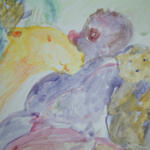
Sketch artist in the preparation of fairy tales.
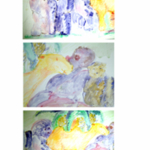
Sketch artist in the preparation of fairy tales
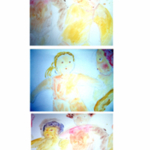
Sketch artist in the preparation of fairy tales
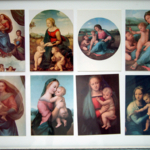
Iconographic repertoires of the artist