
ROOM 2. THE UNREALISED, THE MUSEUM AND THE ARCHIVE
“I think of the beauty and freshness of preparatory drawings for paintings, scale models, or brief descriptions accompanied by drawings. The idea of a virtual rather than a physical museum is appealing because it facilitates visitors’ engagement with the museum, its works, and the community itself.”
Debora Hirsch
One of the projects donated to MoRE is Museo degli artisti dimenticati by Cesare Pietroiusti. The project consists in “looking for very talented artists” who have been forgotten, in order to rewrite an alternative history of contemporary Italian art over the last three decades (c. 1970–2000).
We choose to begin here because the theme of the unrealised in twentieth- and twenty-first-century art cuts across the broader issues surrounding the art system and the role of institutions today. MoRE and its archive stem from similar premises, seeking to move beyond conventional project-based and production-oriented approaches in order to investigate the hidden, rejected, or aborted projects of contemporary artists and to identify lines of research into the ways in which art is made today.
Museo degli artisti dimenticati, like the realised project Museo dell’arte contemporanea in esilio, also relates to another unrealised work donated by Cesare Pietroiusti to MoRE, Mine vaganti. The latter sought to “create” arbitrarily the identities of non-existent artists or critics, so that they could actively contribute to the art system through their fictitious, deliberately constructed professional identities, producing false works or interventions, or even exhibitions that were appropriately communicated and publicised.
The concept of the digital archive, by contrast, can be situated more precisely within the contemporary debate, where it is associated with the ideas of democratisation, shared accessibility and usability, as well as with the optimisation of collection preservation. Numerous examples have emerged in this field, including the European project Digitizing ideas, recently presented at MoRE by curator Jasna Jaksic.
Further and equally interesting reflections have been developed in recent years by museum directors themselves, who have had to confront the costs and complexities of museum structures. One example is Marina Pugliese, director of the Museo del Novecento in Milan, who proposed the idea of a museum-archive dedicated exclusively to projects that could be realised on specific occasions.
After all, one of the main challenges involved in creating an archive such as ours is preservation, the migration of formats, and the quality of the materials preserved, just as in a physical archive, with the additional issue of the reversibility of the formats themselves. The quality of project material (also discussed by Alberto Salarelli in his contribution on MoRE) is closely connected to the specific nature of the artist’s practice and consists of digital copies of pencil or pen sketches, notes on paper and in notebooks, typescripts, maquettes, videos, renderings, and so on.
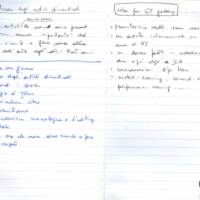
Cesare Pietroiusti. Museo degli artisti dimenticati (2000)
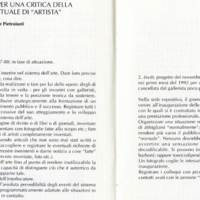
Cesare Pietroiusti. Come si diventa artisti (1992)